Understanding antibacterial resistance, investigating promising cancer treatment targets and identifying fall risk with new technologies were among 13 innovative Burnett School of Biomedical Sciences student projects presented at a recent spring research symposium.
In its 20th year, the symposium brings together graduate and Ph.D. students and faculty in a conference-style setting to familiarize students with sharing their research.
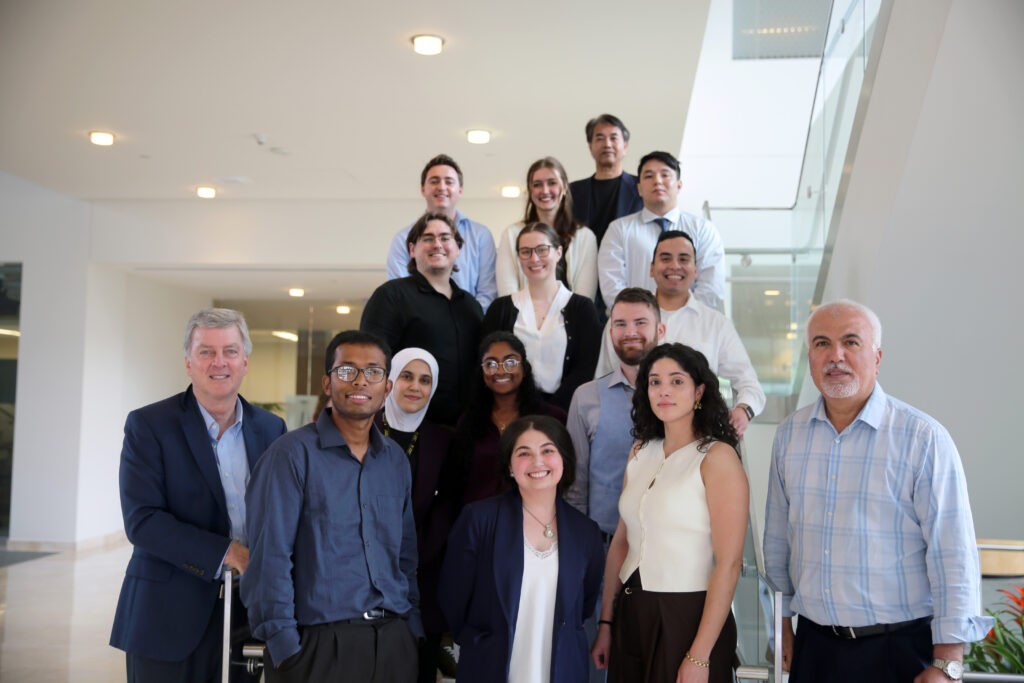
“This is a great annual opportunity for Ph.D. students to showcase their thesis research work and their skills like a true scientific researcher,” said Dr. Jackie Zhao, professor and Biomedical Sciences Ph.D. program coordinator. “This event provides them with a great stage just a like professional research conferences to share their research, interact with others, exchange ideas, and initiate collaborations.”
Third-year Ph.D. candidate Anna Schulz won first place for her work linking vitamin B2 (also known as riboflavin) with the bacterium that causes Lyme disease. She said she hopes her findings serve as a reference point for further studies to better understand how the tick-borne illness spreads.
The results are a product of her research guided by Dr. Mollie Jewett, head of Burnett’s Immunity and Pathogenesis Division.
Schulz praised UCF for providing a balanced academic path that blends an immersive education with a “strong and supportive community” where “fellow researchers provide frequent beneficial feedback and words of encouragement.”
Payton Bowman, a third-year Ph.D. candidate who won the audience choice award, credited her mentor, Dr. Hubert Salvail, a faculty researcher who investigates drug-resistant salmonella.
“He has not only helped me in developing lab skills, but also taught me how to communicate my findings,” she said. “He has given me the space to grow on my own while also providing me with the support and guidance I needed. These symposiums allow me to develop further skills in showcasing my research, and in properly addressing audience questions as preparation for conferences in the future.”
Bowman’s research focuses on better understanding how the body reacts to a salmonella infection, hoping that the molecular response will help create better therapies.
Although she’s undecided whether she’ll seek a career in academia or industry, Bowman said her UCF experience will carry her forward.
“I would like to continue working with pathogens, either to investigate fundamental aspects of virulence or to be involved in drug discovery,” she said.
Fourth-year Ph.D. student Christina DeBarro placed second for her research that uses peptides to counter drug-resistant bacteria. As part of her work in Dr. Renee Fleeman’s lab, DeBarro found that the specific structure of these peptides can alter their efficacy.
“This conference gave me the confidence to learn more and add additional components to the project to make it more interdisciplinary,” Debarro said. “Eventually I’d like to work in a hospital setting if possible or remain close to academia. Most importantly though, I’d like to continue to broaden my understanding of infectious diseases as a whole and more specifically drug discovery and molecular mechanisms.”
Faculty judges awarded the top presenters a cash prize based on presentation and research impact. The symposium added a third award category where the audience chose their favorite presentation. Here are details of the winning presentations:
- 1st place – Anna M. Schulz | Mollie Jewett lab
- Project title: Riboflavin Salvage Supports Glycolysis in Borrelia burgdorferi through Flavin-Dependent NAD+ Regeneration.
- 2nd place – Christina DeBarro | Renee M. Fleeman lab
- Project title: Colistin Resistance: Challenging the Precedent.
- Audience Choice – Payton Bowman | Hubert Salvail lab
- Project Title: Post-transcriptional control of guanidine efflux by a small RNA and an RNA chaperone challenges the paradigm of riboswitch-mediated gene regulation.