College of Medicine students presented their original research May 11 — on topics ranging from cancer to whether patients trust when their doctors use artificial intelligence — as their dean was honored for creating the Focused Individualized Research Experience (FIRE) course 20 years ago so UCF physicians-in-training could advance medical knowledge.
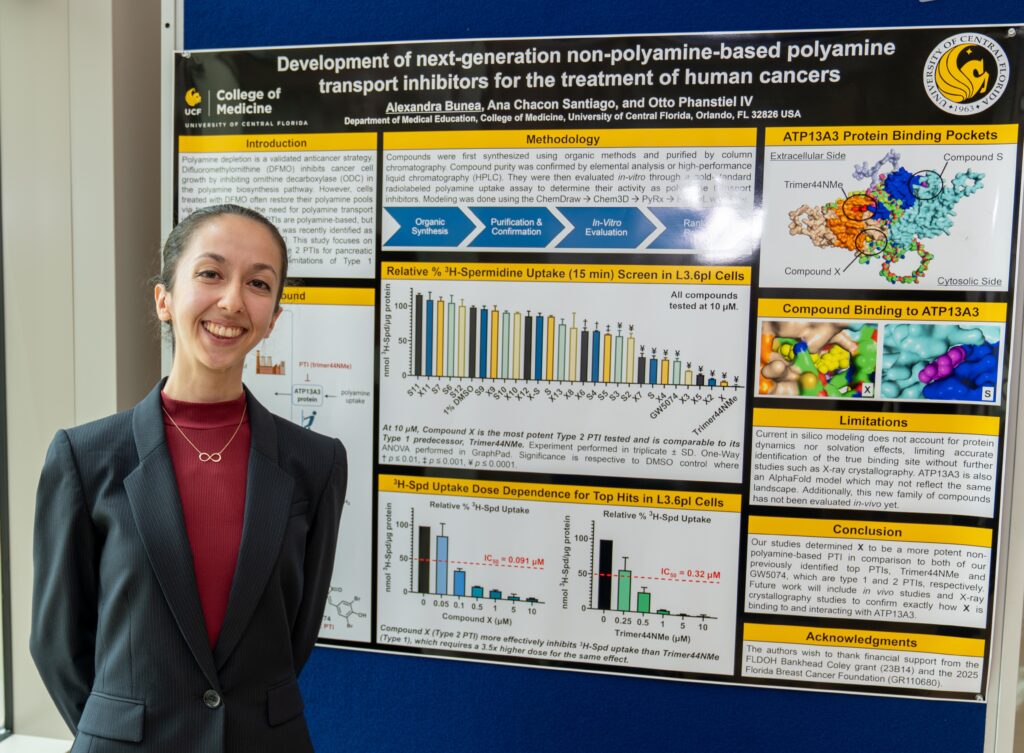
FIRE leaders announced the Dean Deborah C. German, M.D. FIRE Impact Award that will be given each year to a student whose research has the most potential impact for improving patient care and/or biomedical research. German announced earlier this year that she will be transitioning away from her roles as vice president for health affairs and founding dean.
UCF’s medical school is unique nationally because it requires every student to conduct a two-year research project. As FIRE faculty leader Robert Hines said in presenting the award to German, the research course inspires UCF Physician Knights to develop a scientific brain that says, “How can I become a better doctor? How can I improve patient care? How can I improve the practice of healthcare?”
Second-year students delivered oral and poster presentations on their findings in a variety of medical topics, including autoimmune disease, changing public perceptions on vaccinations, gestational diabetes, suicide prevention and Parkinson’s Disease.
Innovative Therapies to Fight Cancer
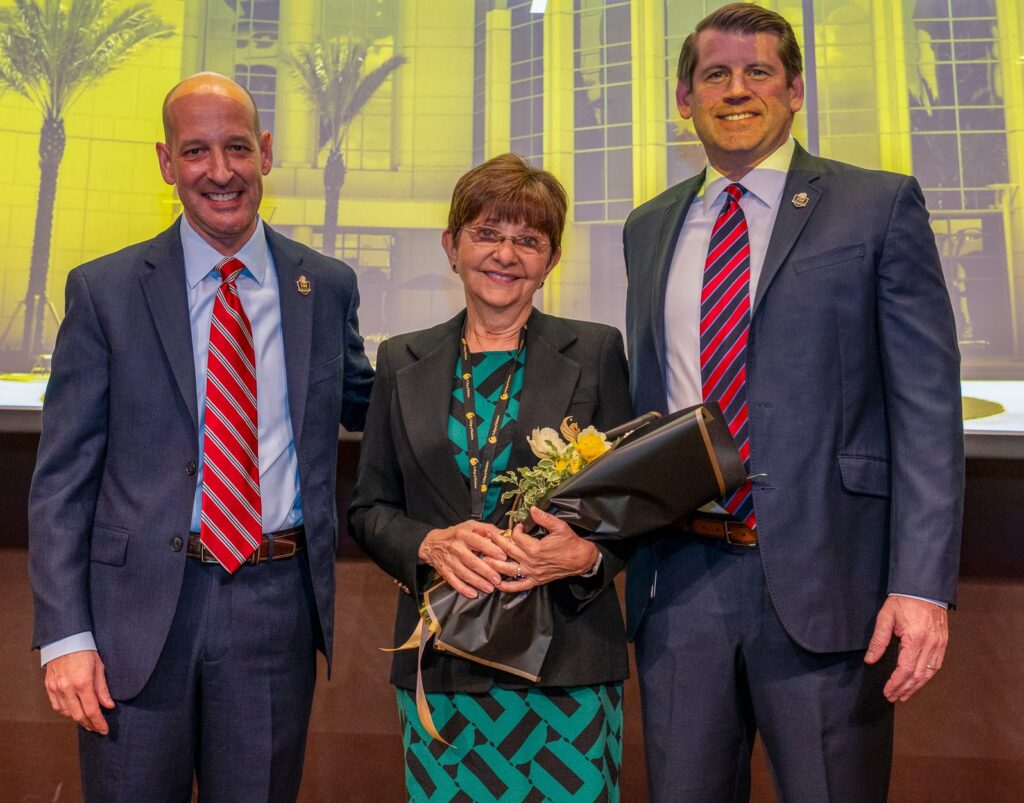
Alexandra Bunea lost her grandfather to pancreatic cancer during the pandemic and because he was living abroad, she never had the chance to say goodbye. Grieving, the College of Medicine M.D./Ph.D. candidate learned about the work of Otto Phanstiel, a College of Medicine cancer researcher. “When I learned about Dr. Phanstiel’s lab I thought, ‘It’s a sign. This is where I’m meant to be,’” she said.
At the FIRE Conference, she was one of 18 students selected to give oral presentations. She and other researchers on Phanstiel’s team are looking to create a cancer therapy that uses cancer cells’ “addiction” to polyamines, organic compounds that are essential for cell growth. Cancer cells hijack polyamines to evade the body’s immune response. The team has created a two-part therapy that shuts down the ability to make polyamines in specific areas of the body, where there is cancer, and also stops cancer cells from importing polyamines from other parts of the body. The treatment has had success in the lab against pancreatic, breast, colorectal cancer and melanoma.
“Healthy cells need polyamines like we need water,” she said. “we can go a few days without it. Cancer cells need polyamines like we need oxygen.”
Do Patients Want Their Physician to Use AI?
Zachary Ehrlich researched whether a physician’s use of artificial intelligence in a clinical setting impacts patient trust. Through patient surveys at UCF Health Faculty Physician Practice, he discovered that patient opinions on AI were tied to trust in the physician. The more patients trusted their physician, the more comfortable they were with the doctor using AI as part of care. The opinions were consistent whether patients had a simple ailment – like a cold – or a complex disease such as autoimmune conditions.
“The more trust patients had in the doctor, the more trust they had for the doctor to use AI responsibly and not as a crutch,” he said.
Helping Predict Childhood Disabilities
Vanessa Rodriguez worked with her FIRE mentor, Caroline Chu at Nemours Children’s Health, to study better ways to care for newborns with hypoxic-ischemic encephalopathy (HIE), brain damaged caused by a lack of oxygen during birth.
Hospitals treat these newborns with therapeutic hypothermia, lowering their body temperature for several days to reduce brain injury and death. While hypothermia has reduced death rates, Rodriguez looked at ways to better predict the level of brain damage babies will have when they become infants and toddlers. Her research showed that taking an MRI of the baby’s brain three or four days after hypothermia could give caregivers and parents a better idea of their child’s future prognosis.
“This is powerful information that can allow us to be more proactive with interventions, counseling and follow-up care,” she said.
Chu said Nemours treats about 15 cases of hypoxic-ischemic encephalopathy a year and that the study could help the hospital change treatment protocols for such infants. She applauded Rodriguez’s research project and UCF’s FIRE course. “Research is important,” she said, “because these students are the future of medicine.”
“Seek Environments that Challenge You to Shine”
The conference’s plenary speaker was Husain Sattar, professor of pathology at the University of Chicago and founder of Pathoma.com, an education platform on pathology that has 400,000 website visits a month from medical students across the world.
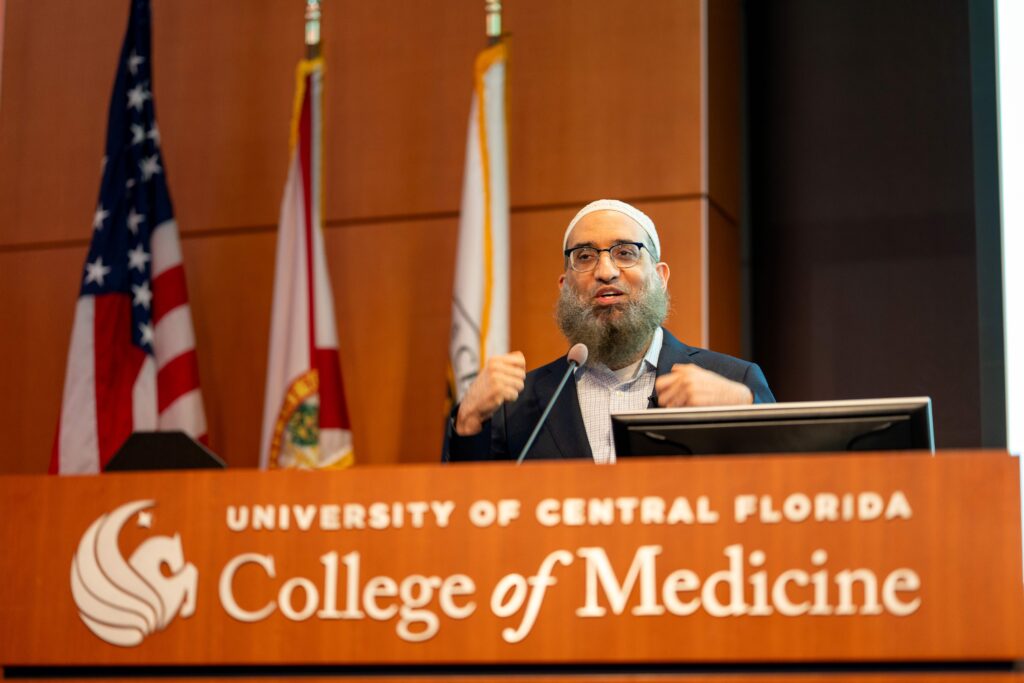
Sattar told students his journey through academic medicine that included transitions between specialties, combining his love for research that brought him to patient care, and his decision to step away from medical school to find himself.
He used his personal experience to give advice to UCF medical students, urging them to find a specialty that fits their strengths and never to “take your foot off the accelerator.”
“Use the world as a mirror to determine your strength,” he said. “Seek environments that challenge you to shine.”
FIRE Conference winners will be announced at a later date.