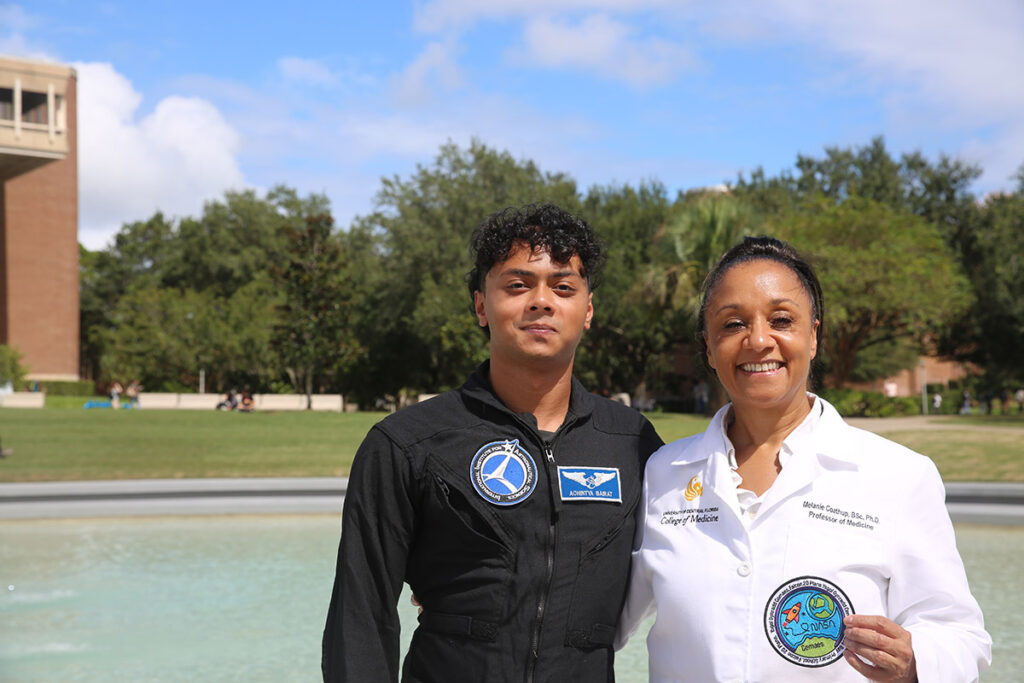
UCF College of Medicine Professor Dr. Melanie Coathup recently found herself back in her primary school classroom in Wales.
But instead of sitting at a desk facing a teacher, the orthopedic and space medicine expert addressed the class through a computer screen in hopes of sparking interest in STEM careers for dozens of energetic young students.
Dr. Coathup partnered with UCF aerospace engineering graduate student and NASA intern Achintya Bairat for a series of interactive international calls that illuminated STEM opportunities – and even brought the students closer to outer space.
“It’s a very rural and quiet area,” Dr. Coathup said of the school, which is located two hours west of Liverpool in a region called Cemaes Bay. “We tried to make sure the students knew that space and the goals of NASA are relevant to their lives. It can seem like NASA or space is just a dream, but I want to help them recognize that they can get there and that it is achievable.”
Igniting Imaginations
Dr. Coathup invited each student to design a flight patch. The most creative one would be selected to hitch a ride with Bairat onto a parabolic flight in October as part of a National Research Council Canada mission.
During a parabolic flight, a plane quickly maneuvers up and down to simulate weightlessness for about 30 seconds. As part of his NASA research, Bairat boarded the plane on October 9 and tested the viability of mixed reality heads up displays in microgravity for training, simulation and displays to assist with flight operations or exploration.
“I told them that their mission was to make a patch that would float in one of these planes, and all their little heads shot up and nodded when I asked if they wanted to do that,” Dr. Coathup said.
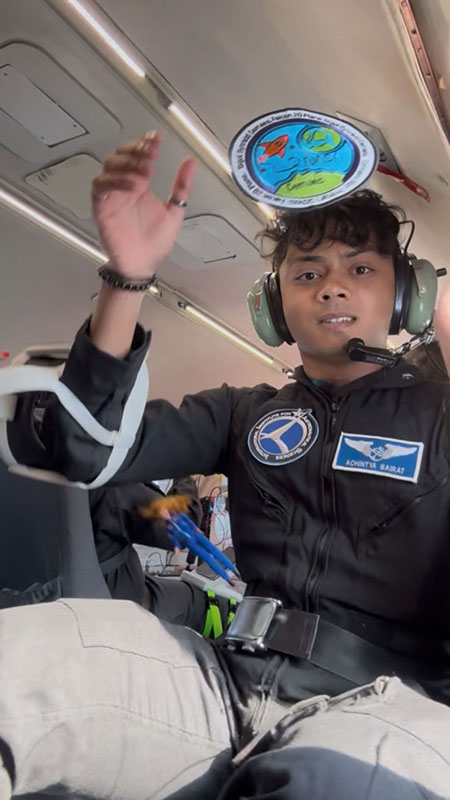
Before boarding, Bairat put the winning patch into a pocket in his flight suit and released it when microgravity was achieved.
On an international video call after the flight, he shared a recording showing him releasing the patch in microgravity.
From their classroom in Wales, the students gathered around a large screen and watched the patch float in weightlessness high above Canada.
“I can’t believe a patch designed here with the name of Cemaes School actually was on a flight!” one exclaimed.
“I want to experience microgravity!” said another.
“One day I’d love to get to go to NASA!” said a third.
Isabelle Hughes, 10, was even more enthusiastic when Dr. Coathup announced that her patch was chosen, and she saw it floating in flight.
“I was so happy and excited,” she said. “It was great because we all worked together, helped each other and shared ideas before making our final designs. I’m just so excited to have had the badge and seen it. I’m going to keep it forever.”
The collaboration was launched a year ago when Dr. Coathup reached out to her hometown friend, Ceri Hughes, who is the school’s deputy head mistress. The students were part of an exercise to use internet search engines, and they were prompted to research Dr. Coathup and ask her about her profession as a scientist.
“We reminded them that I once sat in that very same classroom that they are in, and how important it is to be curious and to pursue your dreams,” Dr. Coathup said. “They, to,o can go to Liverpool, London, Orlando and even to space if that is their heart’s desire.”
The series of interactive calls with the students culminated into something bigger when Dr. Coathup gradually explained more complex topics such as how astronauts float and how space impacts the body.
Lifelong Learning
Coathup recalls getting interested in medicine at a young age and becoming fascinated with the concept of orthopedic implants. That inspiration followed her from Wales to Florida, where she leads the interdisciplinary Biionix cluster and conducts research that aims to protect bones of both everyday people and astronauts.
She believes one of the biggest challenges prospective STEM students face today is keeping the spark alive.
“We don’t want to just inspire young minds, but to have them hold onto that inspiration as they mature into teens and adults,” Dr. Coathup said. “I think that capturing their imagination at this early age and encouraging them to think, question and create new ideas and concepts can help them to persevere and develop STEM careers into the future.”
Maintaining an interest – especially in areas with limited avenues to learn about STEM career pathways – is something Bairat is familiar with.
His family emigrated from a rural area in India, and his parents, who are both engineers, encouraged him to attend STEM middle and high schools.
“When I went back to where we’re from, the town’s computer lab was really just spare computer parts and it wasn’t always easy to even access the internet,” Bairat said. “In rural areas, it can seem far-fetched to even dream about STEM. So for me, speaking to these students on the other side of the world, it’s really exciting to get a chance to open those doors.”
Dr. Coathup and Bairat were delighted to see how receptive the students were to their stories.
“I could easily feel the excitement through the screen, and I felt overjoyed to see their reaction,” Bairat said. “They were asking great questions.”
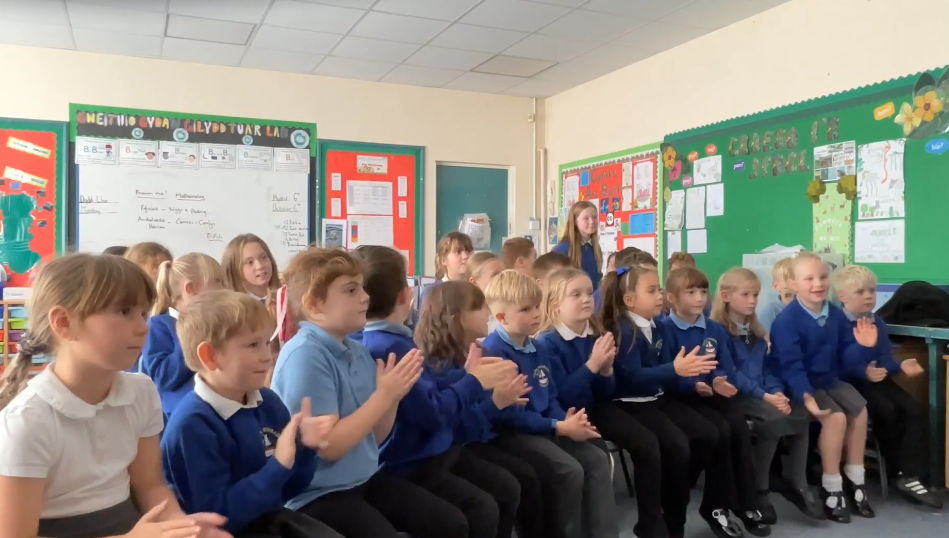
Dr. Coathup says she will continue encouraging students at her former school in hopes that they too can be at the forefront of STEM.
“We received an enormous welcome when we joined the call and an even louder [in Welsh] ‘tan tro nesa,’ or in English, ‘until next time,’ from them when we hung up,” she said. “We plan to set up more focused space-themed projects for the students, and with the goal of supporting and affirming their curiosity and imagination.”