For generations, scientists have looked to the genetics inside immune cells for ways to improve how the body fights disease.
Now, a research team led by UCF College of Medicine assistant professor Hung Nguyen is examining an understudied molecule within T cells as a pathway to treatments for cancers, infections and autoimmune disorders.
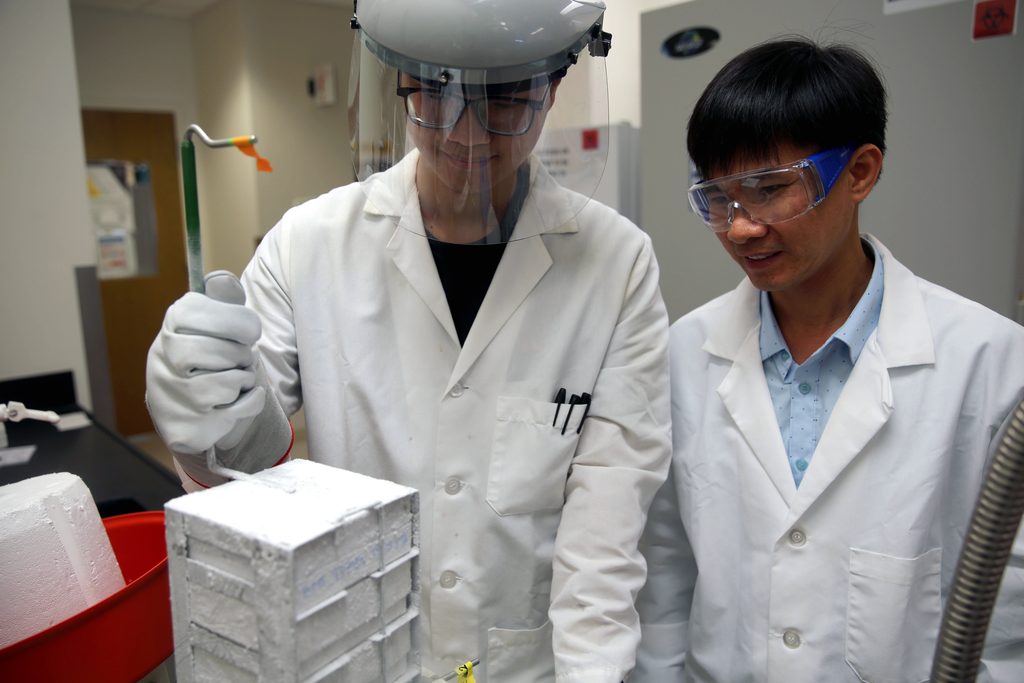
Their study, recently published in Trends Open, focuses on transfer RNA (tRNA), molecules within cells that help build proteins to energize themselves. Nguyen is working to chemically modify these molecules to expand the function of T cells, specialized white blood cells that are the cornerstone of the body’s immunity. The findings represent an important first step toward understanding whether tRNA can eventually be manipulated to fine-tune immune responses to multiple diseases.
T cells play a key role in identifying and killing invasive abnormalities within the body, including infections and cancers. The cells also allow the body to remember previous infections and respond more quickly if re-infected or attacked, says Cuong Pham, a biomedical sciences Ph.D. candidate working under Nguyen who served as the study’s first author.
“T cells are already central to modern medicine,” Pham says. “At the same time, we still do not fully understand all the molecular mechanisms that determine how T cells become activated to respond. Our review brings together emerging evidence showing that tRNA modifications can help support and regulate these responses.”
This discovery comes as a continuation of Nguyen’s efforts to find innovative immunotherapies for a wide range of conditions. An early career researcher, Nguyen earned a “Reach for the Stars” award from UCF in 2024 for his potential for significant impact.
An Innovative Approach to Immunity
UCF’s research is the first time scientists have tested modifying mitochondrial tRNA in T cells to change their behavior, Nguyen says.
“We are looking at the tRNA modification within T cells that have never been reported,” he says. “In the field, tRNA modification is not so new. For T cells, researchers have been focusing on all the other parts before now.”
The discovery came as a result of an active project in Nguyen’s lab that is examining how diet can affect the immune response in cancer patients.
“I wouldn’t say we found this by accident, but we were very lucky,” Nguyen says. “We examined the mitochondria of the T cell, and we kept looking at all the different layers and targets and then we arrived at the tRNA.”
Studying tRNA is challenging because the molecules are short and densely packed, making them difficult to analyze and modify, Nguyen says.
So the UCF team used cutting edge technology called liquid chromatography-tandem mass spectrometry (LC-MS/MS). The highly sensitive technique separates massive quantities of molecules in a sample and then identifies and measures them.
“It is very new for use in detecting tRNA, and it was so important for us to see how everything worked,” Nguyen said.
Results Could Impact Other Immunity Research
In the study, the team genetically engineered the tRNA to give T cells signals to activate against specific disease cells.
While the research is still in its early stages, Nguyen says that they have already identified ways to modify T cells to pinpoint and fight melanoma, colon cancer and lupus.
Nguyen says he hopes his new findings will provide a way for other researchers to create new immunotherapies.
“We want to share these ideas with the greater science community and bring everyone together to help us validate them and ultimately benefit more people,” he says.
Drawn to UCF for its opportunities for interdisciplinary research, Pham says he’s looking forward to being a part of what’s next in the College of Medicine’s immunology efforts.
“The next step is to move deeper into the mechanisms behind these observations,” Pham says. “Our lab has strong and ambitious research directions in immunometabolism. We want to understand how those changes in tRNA influence T cell metabolism and function, and whether specific pathways can eventually be targeted to ultimately help patients.”
Minh Tuyet Le Nguyen, a UCF postdoctoral scholar, and the Hanoi University of Pharmacy in Vietnam also contributed to the research.
Research reported in this publication was supported by the National Heart, Lung, And Blood Institute of the National Institutes of Health under Award Number R01HL166820. The content is solely the responsibility of the authors and does not necessarily represent the official views of the National Institutes of Health.