With the widespread use of artificial intelligence (AI) to learn and inform clinical skills, UCF College of Medicine students are creating a space to help their classmates better understand how to use those tools responsibly while remaining focused on patient-centered care.
The AI in Medicine Interest Group (AIMED) held its first two meetings in September, bringing together nearly 40 students to discuss AI’s growing role in medicine and share best practices for responsible AI use.
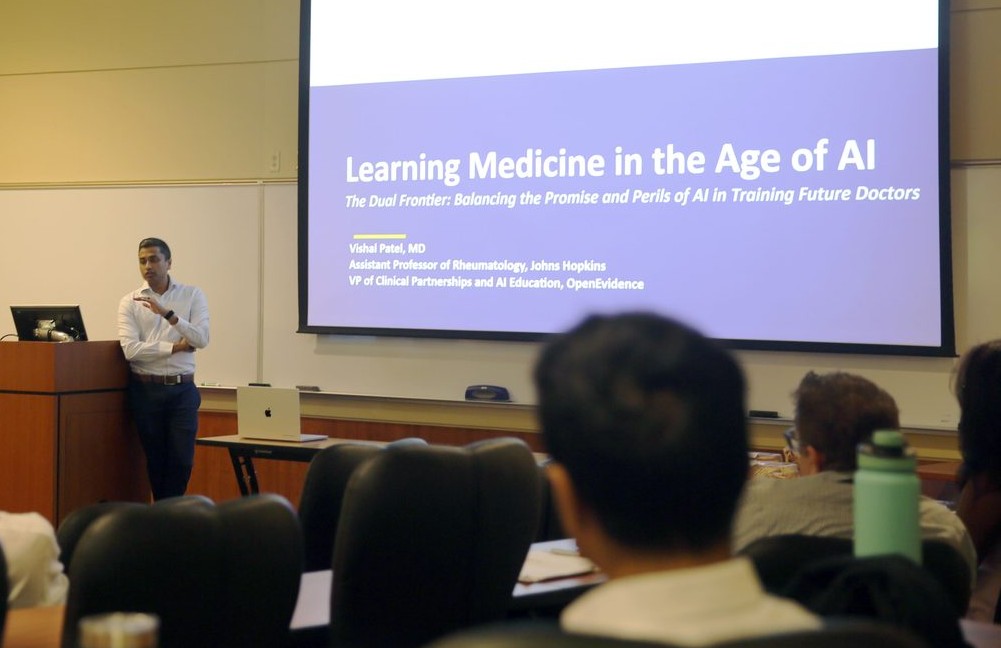
The group was founded by second-year medical students Sophia Velasco and Alejandro De Los Angeles, who saw how swiftly AI is changing the way students learn. They used AI as a study tool during their first year and through their conversations on AI use for medical education, they were inspired to create AIMED to help students keep pace.
“It’s moving incredibly fast right now,” says Velasco, who serves as the group’s president. “I wouldn’t be surprised if we go into our residency and our future practice and the physicians we work with are using AI in some capacity. So, I want AIMED to be a space to be curious and to explore this transformative tool in medicine.”
AIMED and its programming are meant to be accessible to everyone regardless of their previous experience, says De Los Angeles, whose student research projects focus on AI and is the group’s vice president.
Creating a Space to Learn
Velasco already had a deep interest in AI through her Focused Inquiry and Research Experience (FIRE) project. She approached physiology professor David Harris last fall for mentorship on a research project on how students use AI throughout medical school.
Harris, interim associate dean for students, researches active learning and medical education. He believes AI could have potential applications in medical education, including creating practice materials and identifying areas where students may need additional support.
“We’re all learning AI together in this rapidly evolving field and so this seemed like a great opportunity,” says Harris. “We’re still wrapping our heads around what it is, how powerful it is and what are our roles. I think it can be a great study tool outside of the classroom, but you need to keep in mind the importance of constantly checking the accuracy of what’s being put out.”
Learning How AI Fits Into Medicine
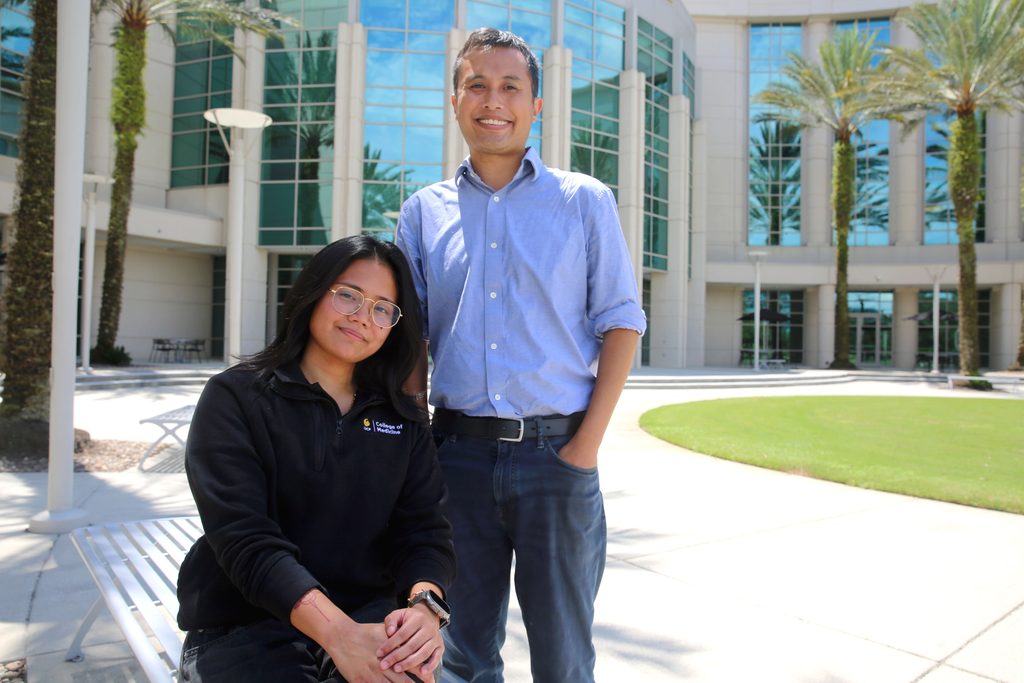
AIMED’s first events featured presentations by Pegah Khosravi, a College of Medicine associate professor with a joint appointment in the College of Engineering and Computer Science, and Vishal Patel, vice president of clinical partnerships and AI education at OpenEvidence, a free AI-powered search engine for physicians that uses clinically validated information.
De Los Angeles said the OpenEvidence session was an example of what AIMED hopes to bring to the College of Medicine community, including practical guidance for how AI can be used in clinical medicine.
Aiming for the Future with AIMED
Velasco says AIMED plans to expand beyond general discussions and explore how AI is affecting different medical specialties by collaborating with other College of Medicine student interest groups.
“We’ll bring in researchers working with AI and other clinicians and learn from them to see how they are using it responsibly,” she says. “We want our club to be a space where we can host experts, not just in AI, to see how AI is transforming their space.”
Harris sees an opportunity for AIMED to address uncertainty surrounding AI while keeping patient care at the center of the conversation.
“My hope for this club is that it continues to inform and educate,” he says. “I think there’s a lot of fear or uncertainty out there, so I think this group can be a great place to help clarify a lot of the questions we all have about AI in the medical world.”
To learn more about AIMED, please visit or follow @ucf.aimed on Instagram.