Why does one person suffer from allergies, while another is completely unfazed by pollen? How can medicine find ways to treat the deadliest and most drug-resistant cancers? These questions may one day be answered, through faculty and graduate student research in Lake Nona’s Medical City.
P. Daniel Poulson is one of those scientific explorers. He is an M.D./Ph.D candidate at the UCF College of Medicine. His two doctoral degrees will allow him to be a physician scientist. During his Ph.D. training, he is a member of Dr. Justine Tigno-Aranjuez’s lab whose research seeks to understand the linkage between inflammation and an individual’s allergic response to common allergens like cat hair and dust mites.
An individual’s unique allergic reactions, Poulson’s hypothesizes, may come down to dendritic cells. These cells play a key role in our immune system by taking in stimuli and initiating a coordinated immune response. While that response is key in protecting the body from invading pathogens, some patients’ cells also activate when exposed to benign stimuli, like cat hair or dust mites.
“We looked at 255 markers on the surface of dendritic cells and what changed after they were exposed to three different allergens,” Poulson said. “We found that there’s a distinct signature of the samples in people that were asthmatic vs. not and an indication that’s different in allergic people vs. not.”
Whether these differences are the result of or are caused by a person’s predisposition to allergies remains to be seen, but research like Poulson’s is giving future scientists better insights into the functioning of the dendritic cells and may provide a pathway to novel allergy treatments.
“When a person has allergies right now, we treat the symptoms,” he said. “But if we can stop it at the dendritic cell level, maybe we could stop it completely.”
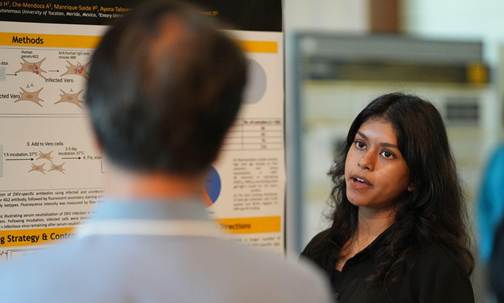
Poulson is just one of the dozens of students who presented their findings at the Burnett School of Biomedical Sciences’ Fall Research Symposium, an annual event where students share research with one another and faculty to encourage collaboration and enhance their presentation skills.
“The symposium serves as a platform for graduate students to ask a wide range of questions and get advice from biomedical graduate program leaders and as an in-person showcase of the most updated research going on at the Burnett School of Biomedical Sciences,” says Professor of Medicine and symposium chair Dr. Jackie Zhao.
Joseph Goode is a Ph.D. student who comes from a family of engineers and nurse practitioners. He is applying both of those perspectives in the lab of UCF cancer researcher Dr. Deborah Altomare. His goal: Find new ways to make immunotherapy more effective against pancreatic cancer, one of the deadliest forms of the disease.
Cancer cells rely on polyamines, small organic compounds crucial for cancer’s growth and their ability to evade the immune system’s response.
“Cancer cells take advantage of these polyamines and thrive,” he said. “But if we can starve them of these polyamines they use as fuel, our immunotherapies may work better.

Goode’s research looked at the combination of a polyamine blockade, a therapeutic strategy that seeks to starve cancer of polyamines, and traditional immunotherapy drugs in mouse models. This combined treatment significantly reduced the size of tumor, while increasing the anti-tumor properties of the body’s immune cells.
“We want to take this further,” Goode said. “We are writing grants to move this research toward human trials as a pre-operation treatment. We hope that after the cancer is removed, this will stop it from recurring.”
Congratulations to the winners at this year’s Burnett Fall Research Symposium:
Best PhD posters –
· Joseph Goode, from Dr. Deborah Altomare lab, “Overcoming Immunosuppression in Pancreatic Cancer: Efficacy of Polyamine Blockade and Anti-PD-1 Combinational Therapy”
· Jonatas de Mendonca Rolando, from Dr. Dinender Singla lab, “Inflammatory Mechanisms of Ponatinib-Induced Cardiotoxicity”
Best MS poster-
· Isaac Trees, from Dr. Kai McKinstry lab, “Naive CD4 T cells rely on each other to generate optimal effector responses”
Best Postdoc poster-
· Sobur Ali, from Dr. Taj Azarian lab, “The Impact of COVID-19 Pandemic on Influenza Epidemiology and Vaccination Trends in the United States”