NASA’s Frank Rubio holds the record for longest single spaceflight by a NASA astronaut – 371 days – and on October 21, thanks to UCF, he shared his adventures with awestruck primary school students in Wales.
He talked about living on the space station for over year, his upcoming test mission to prepare Americans to again land on the moon – and answered the children’s most important questions – “What happens if you get sick in space?” and “Have you ever seen an alien?”
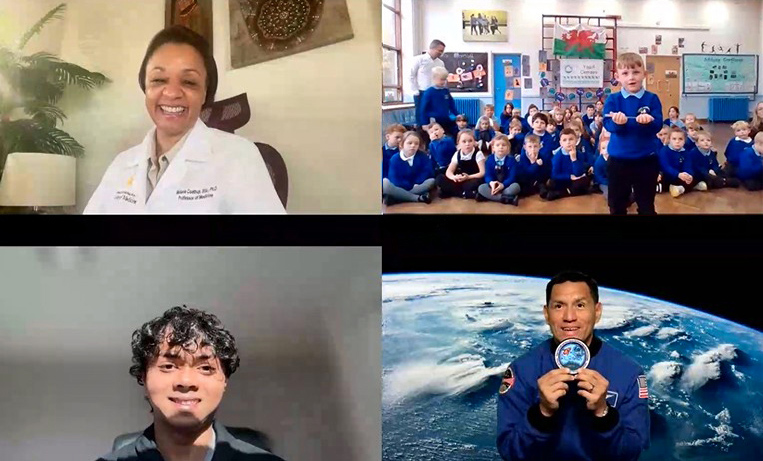
The students of Ysgol Cemaes, a school in the coastal community of Cemaes Bay, Wales, caught a glimpse of space through Rubio’s eyes thanks to Melanie Coathup, a space medicine and orthopedic expert at UCF’s College of Medicine, and Achintya Bairat, a UCF biomedical engineering doctoral candidate and NASA intern. Coathup graduated from the school and the two arranged the video streamed conversation with Rubio to inspire students about science, medicine and dreaming big.
“I know the schoolchildren have been super excited to meet him,” said Coathup, who also leads the interdisciplinary Biionix cluster. “In the days leading up to the call, they’ve brought to school their new books on space and space Lego sets. They had spent a lot of time researching him and all he’s doing at NASA. This truly meant the world to them.”
Coathup and Bairat first connected with school last year through a series of video calls introducing them to space research. They invited students to design a mission patch, with the winning design earning a place aboard Bairat’s parabolic research mission last October to test virtual reality training in microgravity. Meeting a real NASA astronaut who will be a part of next year’s Artemis III mission was the latest part of the inspirational collaboration.
Big Questions, Bigger Answers
So, what about other forms of life in the universe?
“I kept waiting for somebody to come knock at the door,” of the International Space Station, Rubio joked when a student asked about aliens. “But unfortunately, no one ever came. The universe is so big, and it depends on what you consider an alien. It could be a very simple lifeform like a cell or an advanced and intelligent lifeform. Even if it’s out there somewhere, those distances are so far away the challenge becomes, would ever even run into each other? Would we be able to communicate with them?”
The students also asked about everyday life in the galaxy. So, Rubio showed them a dehydrated omelet that astronauts eat and explained how removing water from food prevents bacterial growth and reduces the weight of supplies in orbit. And there were discussions about getting sick in space – and how NASA doctors on the ground can care for astronauts who become ill.
Rubio is very knowledgeable about space health since he’s also a physician and flight surgeon. He told the students his first dream was to become a doctor. In college, he went to flight school and learned to fly helicopters. Then came medical school, military service and the opportunity to become an astronaut candidate. Asked about what inspired him, he emphasized the importance of curiosity and teamwork.
“I love learning, I love exploring, I love teaching other people about thing and I love being part of a great team,” he said.
Inspiring the Next Generation
Coathup and Bairat say they hope that meeting an astronaut inspires students to keep asking questions, explore unfamiliar possibilities and imagine futures that once seemed far away.
“I think it is equally important to educate, inspire, and invite more opportunities to new audiences as it is to do the work itself,” Bairat said. “It is absolutely rewarding seeing others grow and have that same fire in their eyes that I have about space exploration.”
The students are planning their next UCF space project – designing another patch to fly with Bairat next year.
“Our goal is to inspire the next generation who will help move science, engineering and society forward,” Coathup said.