Florida desperately needs more primary care doctors and UCF’s College of Medicine, armed with a $2.6 million federal grant, is doing its part to create those physicians.
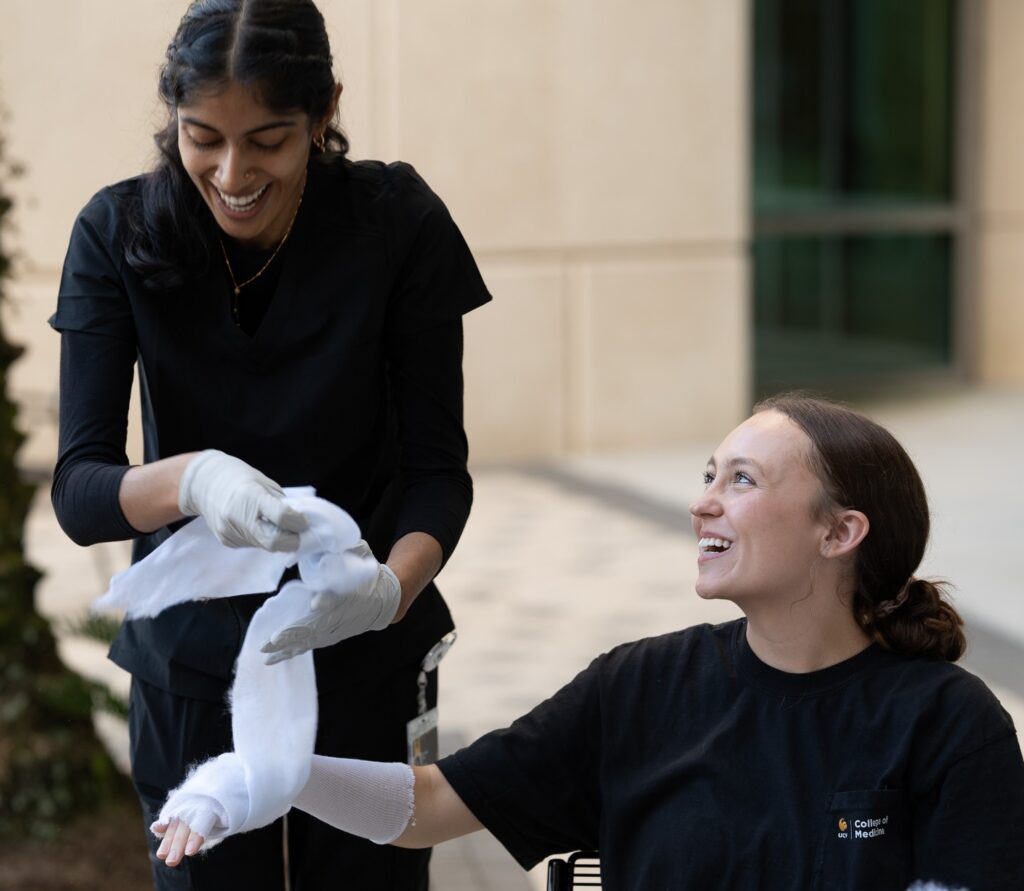
The college’s new Primary Care Scholarship Program is providing about 100 medical students with financial aid and unique clinical experiences caring for a variety of patient groups – from Special Olympians to seniors – to expose them to the broad career opportunities in internal medicine, family medicine and pediatrics. The goal, say college leaders, is to encourage students to stay in state – and perhaps in their own Florida hometowns — to become community physicians.
“Being a primary care physician is about being a part of someone’s life,” says Dr. Jeff LaRochelle, associate dean for academic affairs and an internal medicine specialist by training. “We have students at UCF who grew up in communities that need outstanding, engaged physicians – places like Ocala, Pensacola, Kissimmee, Tallahassee, Gainesville. We are hoping that we can encourage them to stay here and provide needed care to the communities that raised them.
The two-year grant was one of four given this year by the Health Resources and Services Administration to help address the nation’s primary care physician shortage. Medical school leaders hope UCF’s program can be used as a national model and be successful enough to become sustainable after the grant ends.
Florida’s Need for Physicians is Great
Only 73% of Florida residents report having a personal physician. And the nationwide physician shortage hits Florida harder for several reasons. First is the state’s fast-growing population – which is projected to grow by 6 million people in just the next five years. The Florida Department of Health reports a current 12% gap between the supply and demand for physicians, which is expected to more than double to 28% by 2035.
Florida ranks 45th nationally in health access and affordability. Florida’s high percentage of residents over age 65 – 22% and expected to reach 26% by 2035 – require more healthcare services, further exacerbating access to care.
Florida also has more uninsured residents (11.2%) than the national average (8 percent), according to the US Census Bureau. The physician shortage is also more pronounced in rural, remote and under-resourced urban communities.
UCF’s College of Medicine has graduated more than 500 new physicians in the last five years and 36% of those new graduates went into primary care specialties. However, almost 70 percent of those new doctors left Florida for their residency training.
UCF’s new program is designed to inspire graduates to stay in-state while encouraging more students to become primary care physicians. Through a partnership with HCA Healthcare, UCF has Florida’s fastest growing residency and fellowship programs. Dr. LaRochelle hopes the new primary care program will better link UCF’s undergraduate and residency training. “Our hope is to reach out to medical students and offer them a path to do their residency in their hometown and provide needed care to their community,” he said.
In addition, doctors who provide care for communities in need are also eligible for forgiveness for their medical school loans.
Students Say Program Opened Their Eyes, Hearts
First-year UCF medical student Sarah Khan was raised in Kissimmee. She participated in the College of Medicine’s summer Health Leaders Camp, which inspired her to pursue medicine as a career. She worked at a pharmacy before entering medical school and is a Double Knight, who also did her undergraduate work at UCF. She is part of the Primary Care Scholarship Program.
“In the pharmacy, I saw the challenges my neighbors are facing,” she said. “This is the community that helped raise me. This is the community that mentored me. Doctors in this community mentored me. I want to stay here and help improve the health of the people around me.”
In its first months, the program provided multiple extra-curricular experiences for students. They visited Legacy Pointe at UCF and went on rounds with physicians providing primary care to residents at the university-supported retirement community. They did healthcare screenings for Special Olympians participating in a golfing event and were so popular they were invited back to the Special Olympics Florida State Fall Classic.
They did simulated training with residents from the UCF-HCA Internal Medicine residency at HCA Florida Ocala Hospital and learned how to react to multiple emergencies – from asthma attacks in the wilderness to broken limbs.
Primary care scholarship M.D. student Christian Sachs is a self-described “sports guy” who spent his youth playing soccer and even coached the sport. The Sarasota native said he came to med school thinking he might want a more “hands-on” specialty than primary care. Then he spent time during the program working with internal medicine doctors who are sports medicine specialists at AdventHealth-affiliated Rothman Orthopaedics.
He worked on the sidelines of a high school football game where primary care doctors serve as team physicians. “I was able to see when medicine and sports come together,” he said. “When I was playing and coaching, we never had that level of care. If someone twisted an ankle, we had to look for someone to help us know how serious it was. It was incredible to see physicians working with the trainers to provide such a strong level of care for our high school athletes. Standing on the sidelines with them was one of the best experiences I’ve had in medical school.”
Dr. Magda Pasarica, professor of medicine at the medical school, is program director and primary investigator for the primary care program. She is an M.D./Ph.D. whose specialty is family medicine. She hopes the program can expose UCF’s physicians-in-training to all the options for their future, whether they decide to go into primary care or not. “There are so many options in my specialty alone – sports medicine, geriatrics, research. Family medicine allows you to take care of generations,” she said. “It’s where you can impact the health of an entire family.”