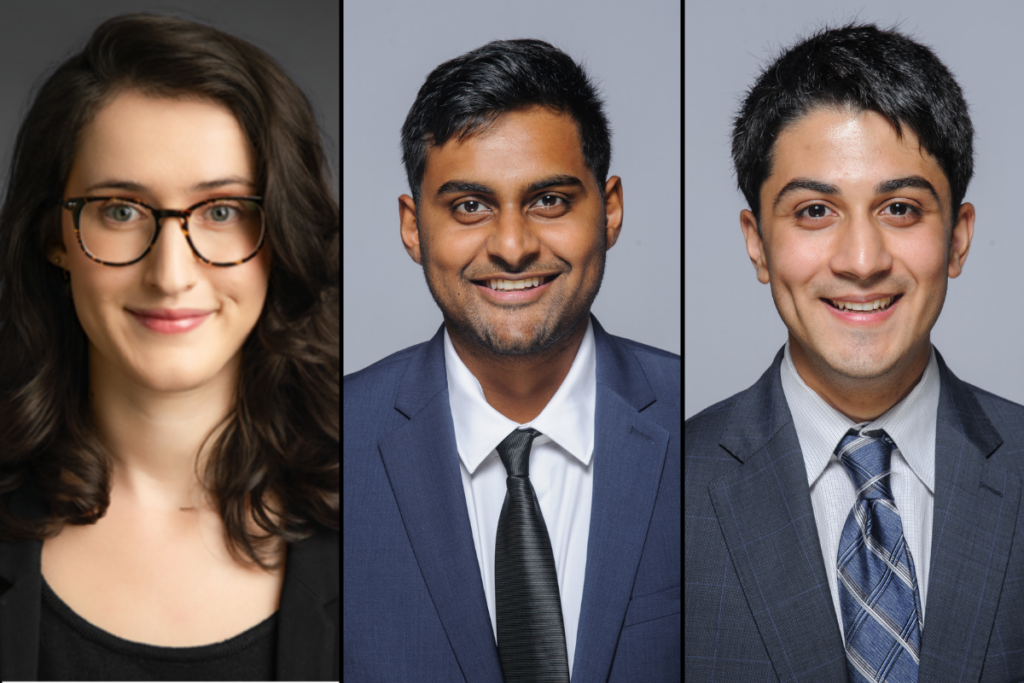
In 2024, Rachel Chapman won a statewide innovation challenge alongside other UCF medical students for a glaucoma screening tool that could be used during yearly doctor’s visits. Her mission: protect vision through early diagnosis and intervention.
Now she takes that dream to the University of Virginia, where she recently matched into ophthalmology.
Chapman is one of three UCF medical students contributing to the College of Medicine’s 100% placement in early residency matches this year. She joins two others who matched into highly competitive ophthalmology and urology residencies ahead of National Match Day, March 20.
Azeem Hasan will train in ophthalmology at the Medical College of Georgia. Avaneesh Kunta will train at the University of Miami in urology.
Before practicing medicine independently, M.D. graduates undergo residency training in their chosen specialty. This graduate medical education (GME) training lasts three to seven years, depending on the specialty.
During their fourth year, medical students interview with residency programs across the country before ranking their top choices. Residency programs do the same. The National Residency Matching Service analyzes the rankings and matches graduates to GME programs. While most match results are revealed in March, military residencies and specialties, such as ophthalmology and urology, match early.
From Future Scientist to Physician
Chapman was pursuing a Ph.D. in biomedical sciences when she decided to become a physician. Through a more patient-centered role, she believed she could better understand the problems patients face and make meaningful improvements to their care.
That was her focus with the EyeSentry glaucoma risk assessment tool. While the American Academy of Ophthalmology recommends a screening eye exam at age 40, there remains no national screening guideline for glaucoma. The eye disease can present as painless peripheral vision loss, leaving many patients with irreversible damage by the time of diagnosis.
EyeSentry is a secure web interface that combines demographics, family history, and medical information with data from fast, painless diagnostic tools that can be used during an annual physical. The system empowers primary care physicians to initiate conversation with patients regarding their glaucoma risk and connect them with local optometrists and ophthalmologists.
The project is seeking its second round of funding to launch a pilot study, providing the system to physicians free of cost.
“Unless patients have preexisting eye conditions that bring them to the optometrist or ophthalmologist, they may fall between the cracks and lose significant vision before being diagnosed. At that point, we can work to save their remaining vision, but we cannot yet restore what has been lost,” Chapman said. “EyeSentry is not just designed to perform risk assessment, but also to educate patients and gather data that could be utilized to develop a national screening guideline for glaucoma.”
Before entering UCF’s medical school, Chapman worked as a scribe in the University of Virgina’s Ophthalmology Department. In June, she’ll return to the same department as a physician.
An Early Adopter
Kunta received his bachelor’s degree in biomedical engineering and that engineering background inspires his medical dreams.
“I have a mindset for pushing forward and being an early adopter. That really attracted me to UCF because that is their selling point,” he said. “You come into the Medical City here, it’s a relatively new school, so that comes with the added benefit that you are in charge of your own destiny and success.”
He said he chose urology as a specialty because it combines his love for helping people through challenging times and his fascination with the robotics and technology used in microsurgery.
“In urology, you’re dealing with very intimate, personal and complex emotions regarding things like cancer and fertility,” he said. “I find that very rewarding.”
Kunta chose the University of Miami after an internship rotation there.
“The residents and culture there are great. It’s a busy place, but you feel supported at all parts of your journey,” Kunta said. “Once I finished that one-month long rotation, I really didn’t see myself anywhere else.”
Ophthalmology is Family’s Passion
Hasan entered college pursuing a degree in international studies, enamored by other peoples and cultures. As a physician, he wants to pair that passion with his love for science to help his patients.
“Every patient has a unique background,” Hasan said. “It’s really fun to explore that in conversations with my patients and help them with the scientific side.”
Hasan will become the fifth ophthalmologist in his family. His father and two uncles who are practicing physicians. His cousin is an ophthalmology resident.
He says this shared profession has created a special connection within his family, as they share their unique experiences in the specialty and learn from one another. He hopes to share his family’s passion and his love of people with his patients.
Hasan says a key value he hopes to embody for patients in addition to skill and knowledge, is empathy.
“Every physician has their own approach, but for me I feel like really paying attention to what the patient says and in turn responding and explaining a lot of the pathology is important,” he said. “Being empathetic, having the patience to explain what’s going on with patients and being a proficient surgeon are three key takeaways that I want to embody my career around to be able to take care of patients fully and comprehensively.”