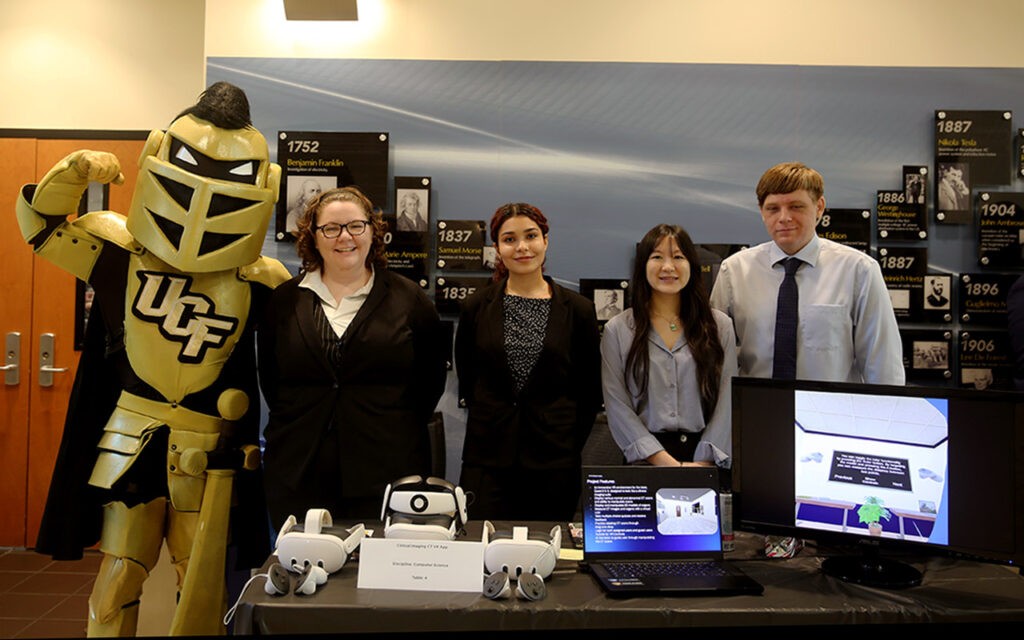
If Nabeeha Vorajee were in a clinical setting, she would need a mask, scalpel and medical scrubs to explore the anatomy of the heart.
But she’s not a medical student and the heart she’s studying isn’t real thanks to new technology she helped develop.
Vorajee is a senior UCF computer science major, and the heart is made of thousands of pixels residing in a simulated classroom accessible through virtual reality (VR).
As part of the UCF College of Engineering and Computer Science Fall 2025 Senior Design Showcase, Vorajee’s research project was one of two that featured UCF College of Medicine faculty mentorship and resulted in new ways for students and medical professionals to collaborate in health sciences and medical education.
Judges selected the two projects to be featured in the yearly showcase because of their quality and potential for real-world application.
The students received invaluable experience and the technologies developed are ready to be further refined by another incoming group of UCF undergraduates.
Understanding Congenital Heart Defects Through Immersive Technology
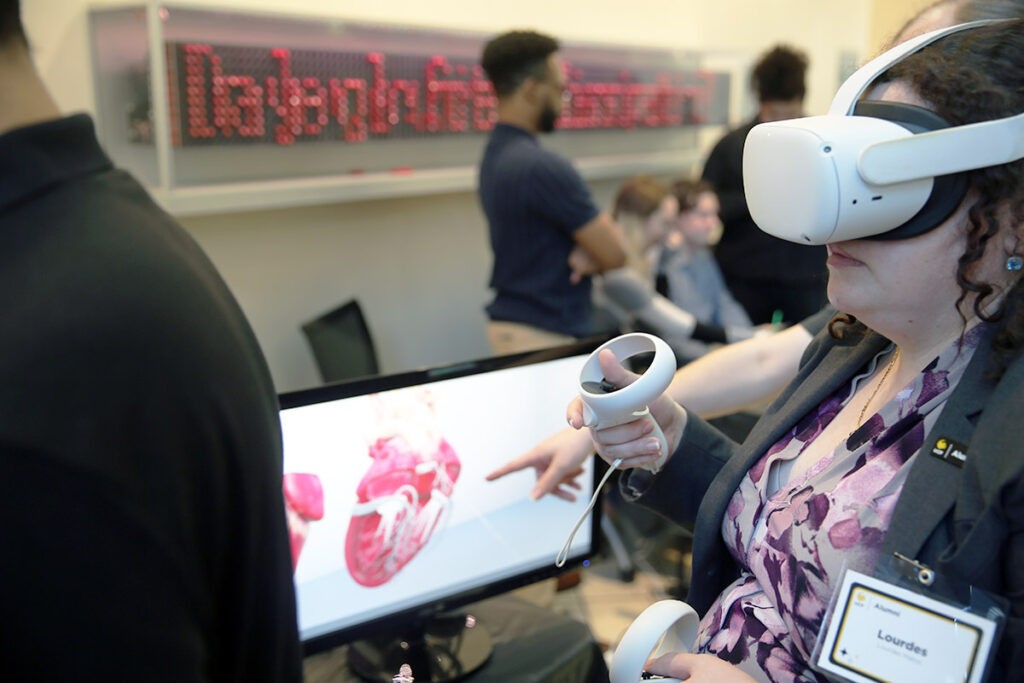
Students wear a virtual reality headset to better understand CT scans of the heart. Using AI, the system categorizes the images for common heart defects. It also creates a 3D digital twin of the heart that students can interact with through the headset.
Vorajee’s team took the learning system a step further and applied it for medical education. They integrated AI learning and the ability to highlight, isolate and segment different parts of the heart. If users have questions about what they’re seeing, they can ask the AI data set without leaving the session.
Users can import cardiac CT scans and transform them into a 3D heart, which allows them to take the model and learn beyond the classroom, Vorajee said.
“Computers and VR headsets are a lot more easily available than an actual heart,” she said. “If a student wanted to study up, they’ll be able to do so a lot easier with this program than they will be able to find a heart.”
Fellow computer science major Jose Hernandez, who worked to implement the AI for the project, says he’s grateful to have had the opportunity to work with an interdisciplinary research team that will prepare him to pursue a career in the emerging field of AI.
“As graduates, we have really good experience with this project that can help us develop the technologies of the future,” he says. “Our project can classify between healthy and diseased hearts, and it can ultimately help save lives. Even though it’s a small project, this is something that can be scaled to something bigger. Within the next five to 10 years, I think AI in medicine is going to be even bigger than it is now.”
The project included guidance and mentorship by Dr. Laura Brattain, associate professor of medicine, and Drs. Matthew Gerber and Richard Leinecker, associate lecturers of computer science.
Dr. Brattain said she saw her students grow significantly as researchers.
“Senior design projects offer invaluable opportunities for students to tackle real-world problems,” she said. “Throughout this project, they not only diligently learned how to use the technology but also expanded on it. At the end of the project, they became fluent with the coding and the platform.”
Seniors Brayden Weber, Francisco Picazo, Anthony Castillo and Julian Mendez also worked on this project as developers.
Clinical Imaging VR
Before pursuing a degree in computer science, Arianna Ramirez Oquendo attended nursing school and used her experience to inform her group’s research project: a VR application to help medical students practice interpreting CT scans.
“When I was in nursing, I realized that most of my practice identifying organ structures and reading CT scans or MRIs was restricted to only lab times,” Oquendo recalled. “I needed more than two or three hours a week to really understand what I’m looking at.”
Oquendo’s group’s system simulates a clinical imaging office where students can compare normal and abnormal CT scans, identify anatomical structures and recognize medical implantable devices.
The app allows students to see and adjust up to 160 slices — or images — from each CT scan. After the tutorial and CT scan room, there is a final study room where teachers can implement multiple choice or “drag and drop” quizzes on specific scans.
“You can see pretty much every part of these scans,” said Ash Hutchinson, a computer science student who also worked on the project. “We wanted to make something that utilizes the CT scans that the UCF College of Medicine gets every single year to help students learn. The students can adjust the CT scans and the 3D model.”
Dr. Emily Bradshaw, an associate professor of medicine and project sponsor, said that this project has great potential to help students and supplement their education.
“Medical students need to become proficient in examining clinical imaging,” she said. “This VR program will help them learn CT. Ideally, this can help students identify organs and understand the relationship between anatomical structures.”
CT imaging can be a difficult radiologic discipline to master because the images are presented in three different planes, said Melissa Cowan, project sponsor and assistant director of instructional technology at the College of Medicine.
“By aligning the CT images to a 3D model of the patient’s skeleton and organs, the students have a visual reference as they scroll through the various views and isolate the key findings,” she said. “This app is another tool to help students learn how to read and interpret CT scans and apply their knowledge to other patient cases presented throughout the curriculum and in clinical settings.”
Oquendo said she and her team are proud of how the project has progressed, it marked a milestone on her path to her dream career.
“We hope to see this project flourish, and someday truly used as part of the curriculum here at UCF,” she said. “After graduating, I envision I’ll continue working on medical projects. That has always been my dream. I want to work in hospitals and make systems that can help people. Hopefully in five years, my dreams will have come true.”
Seniors Michael Biskup, Matthew Eisenberg, Kyle Kratt, Zoe Schlesinger and Thomas Winslow also worked on this project.