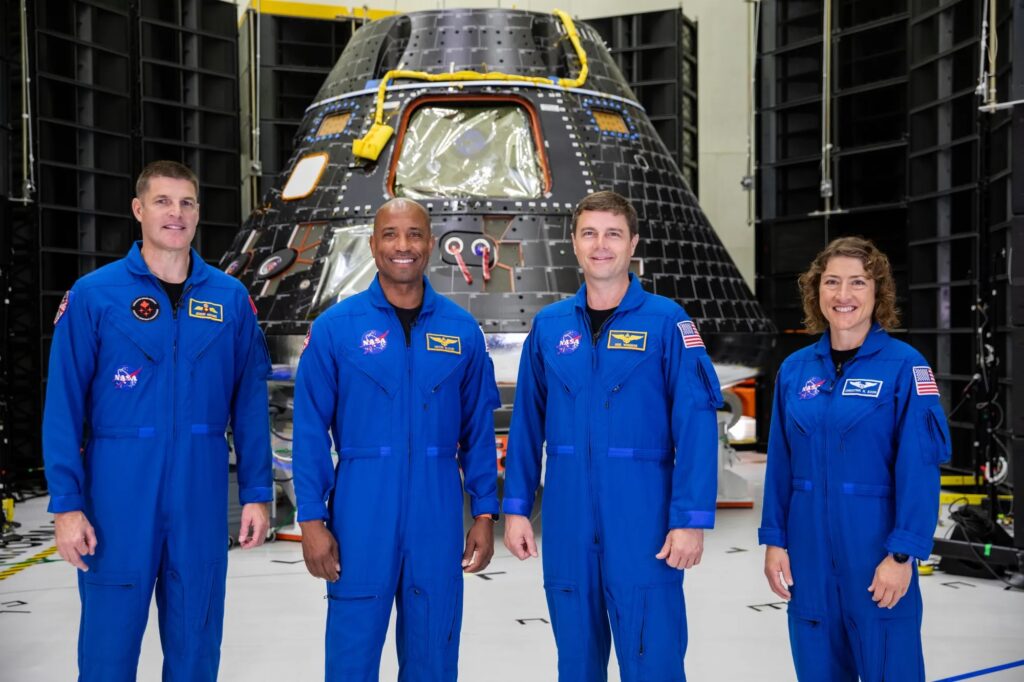
NASA’s upcoming Artemis II launch will witness astronauts orbiting the moon for the first time in more than half a century, providing new opportunities for space medicine research, UCF experts say.
The mission will include multiple health studies on the four astronauts to determine how radiation, microgravity, isolation and other factors impact their physical health, mind and behavior — crucial information that will help pave the way for future lunar surface missions and develop our understanding about humans’ deep space capabilities.
Thanks to new technology and modern medicine, researchers have better ways to understand the impact of space flight on human health.
“Artemis II is both a historic and biomedically important mission,” says Dr. Emmanuel Urquieta, the UCF College of Medicine’s vice chair for aerospace medicine and director of the university’s new Center for Aerospace and Extreme Environments Medicine (CASEEM).
“For the first time since Apollo 17, humans will travel beyond the Earth’s magnetic field. That matters enormously from a research perspective, because now we have technology to thoroughly understand the health impact of embarking into deep space. The knowledge gained from Artemis II will help shape the future of safe human space exploration and drive innovations that can benefit medicine here on Earth and help us start preparing us for a mission to Mars.”
The Space Coast’s College of Medicine
As the closest medical school to the Kennedy Space Center, UCF’s College of Medicine is charting a new frontier in healthcare as humans prepare for longer missions to the moon and Mars, and commercial space flights take more civilians into space.
The goal: explore how factors such as microgravity, radiation and isolation impact the human body in space and how that knowledge can drive innovation into diagnostics, treatment and disease prevention on Earth.
To further those efforts, UCF’s CASEEM includes faculty experts in medicine, engineering, computer science, psychology, arts and educational leadership. This interdisciplinary group will work together to research and develop new technologies for keeping space travelers healthy, as well as soldiers on military missions, deep sea explorers and mountain climbers.
What Lies Ahead for Artemis II’s Astronauts
- Understanding Radiation Exposure Effects
Traveling to the moon — which humans haven’t returned to since 1972 — means astronauts will go beyond Earth’s Van Allen belts, which protect humans from cosmic radiation and solar storms. Space travelers to the International Space Station stay within Earth’s magnetic field. During their 10-day mission, Artemis II is anticipated to break Apollo 13’s record (248,655 miles) for the farthest distance humans have traveled from Earth.
Fifty years ago, researchers could do little more than measure radiation. This time will be different, says UCF’s Dr. William “Ed” Powers, chief medical officer of CASEEM and the former chief of NASA’s Medical Operations branch where he was a primary medical support physician for six shuttle missions.
“Medical knowledge, technology and the ability to diagnose disease have advanced significantly since then,” he says.
Physicians and scientists will be able to determine how radiation impacts cells, organs, blood proteins and other molecular functions.
Artemis crew members will carry dosimeters in their pockets that measure radiation exposure in real time. Monitors inside the Orion spacecraft will also gather radiation information throughout the flight for future analysis.
An astronaut suffering a medical condition in space is always a concern, but deep space travel brings additional challenges, Dr. Powers explains. While astronauts on the International Space Station can be returned to Earth in about a day, as happened recently when a crew member became ill, returning from the moon may take several days or more.
“None of the four astronauts on this flight is a physician,” Dr. Powers says. “And a space capsule certainly doesn’t have the same equipment you’d have in a hospital emergency room.”
- Does Space Flight Reduce Immunity?
Previous research has shown that spaceflight missions alter the immune system and reactivate dormant viruses in the human body. As part of the Artemis II mission, NASA will conduct an AVATAR (A Virtual Astronaut Tissue Analog Response) experiment that will investigate how deep space impacts specific cells and tissues as well as some vital bodily functions including immune system responses.
For this experiment, NASA-funded scientists created “organ-on-a-chip” devices that contain each astronaut’s bone marrow cells. This technology allows scientists to examine molecular changes and cell function.
“With this technology we can see how the body responds to stimuli across the whole mission,” says Dr. Jennifer Fogarty, CASEEM’s chief scientist who came to UCF after serving as chief scientist for NASA’s Human Research Program. “This capability will help us map the body’s molecular changes with tissue/organ function and much better predictive capabilities.”
As the “organ-on-a-chip” technology advances and proves accurate, it will allow NASA physicians to provide personalized and proactive medicine to astronauts because they will be able to predict a crew member’s biological response to space flight. Such technology could be used before NASA sends an actual crew to Mars. The space agency could place the crew’s personalized chips on unmanned flights to the Red Planet to better understand the potential health risks for each individual.
“It’s basically sending small versions of astronauts to Mars before we send astronauts to Mars,” Dr. Fogarty says.
- Teamwork and Behavior
Selecting an astronaut crew that will perform well under the stresses of space flight is always a top NASA priority. But deep space missions present additional personnel challenges, including communication delays, increased isolation and resource constraints.
Astronauts on moon and Mars missions also must live in a capsule that is significantly smaller than the International Space Station, highlighting the need for crews to work together seamlessly and be able to manage any conflicts.
The Artemis flight will conduct an experiment called ARCHeR (Artemis Research for Crew Health and Readiness) that will evaluate how astronauts perform individually and as a team during the mission.
They will wear sleep and movement monitors before, during and after the mission to evaluate their cognition and team dynamics.
“You watch the astronauts on TV, and it looks so easy,” Dr. Fogarty says. “But human performance is critical in space. You have multiple duties to conduct and you’re always pushing operations. So we need to understand how the team performs, their reserve and resilience. The mission itself is the experiment.”
Star Nona 2026
UCF’s leading space medicine experts, valued strategic partners and an astronaut who holds NASA’s record for spacewalks will gather April 10 in Lake Nona’s Medical City to discuss how they can work together to keep space travelers healthy and use that research to create groundbreaking clinical innovations on Earth.
The “Star Nona 2026” event is led by the Lake Nona Research Council, which is focused on encouraging interdisciplinary scientific partnerships between industry, academia and healthcare.
The council includes physicians and researchers from UCF, Orlando Health, AdventHealth, the Florida Space Institute, the Orlando VA Medical Center, Nemours Children’s Health, business and industry.
For more information, including how to register for the event, visit www.ucf.edu/news/progressing-the-final-frontier-of-medicine-space.